Desk work and back pain often go hand in hand, but it does not have to be that way. Most advice about desk posture repeats the same basics: feet flat on the floor, keyboard at a comfortable height. Useful, but there is one detail that makes a bigger difference than most people realise.
The One Thing Most People Get Wrong
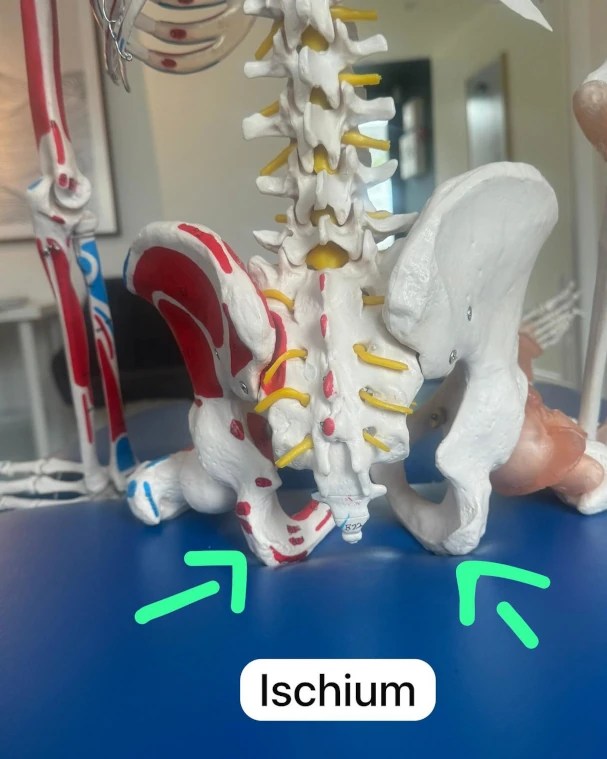
When we slouch, the pelvis rolls backwards and we end up sitting on the tailbone rather than on the part of the pelvis designed to bear weight. The tailbone is delicate and not built to carry load this way, and over time this can contribute to misalignment of the sacro-iliac joints, where the tailbone meets the pelvis, setting off a chain reaction of discomfort all the way up the spine.
The common fix, sitting up straight, often overcorrects into an exaggerated arch in the lower back, which creates a different kind of back pain entirely. The better target sits in between: balancing on the ischial tuberosities, commonly known as the sit bones, the two bony points at the base of the pelvis that are actually designed to bear your weight when seated. Learning to sit on your sit bones, rather than your tailbone, is a small adjustment that can make a meaningful difference to how your back feels by the end of the day.
Why Prolonged Sitting Is a Problem
Our bodies were not designed to hold one position for hours at a time. Prolonged sitting increases the risk of developing problems such as low back pain, carpal tunnel syndrome, frozen shoulder and headaches, and research increasingly points to extended sitting as a health risk in its own right, independent of posture.
Setting Up Your Workstation
A well-set-up workstation supports good posture without you having to think about it constantly:
- Adjust your chair height so your feet rest flat on the floor or on a footrest
- Keep your knees at or below hip level, without crossing your legs, and keep your ankles roughly in line with your knees
- Support your lower back with the chair’s backrest, or a rolled towel or small cushion if needed
- Set the top of your monitor at or slightly below eye level
- Keep your head and neck balanced in line with your torso, rather than jutting forward
- Relax your shoulders and keep your forearms roughly parallel to the ground
Why Movement Matters More Than “Perfect” Posture
Even the best-set-up desk will not fully protect you if you stay in exactly the same position all day. Building in regular movement, standing up, changing position, walking around, is one of the simplest and most effective ways to reduce physical tension, improve comfort at work, and support recovery from existing issues. No single “correct” posture is meant to be held for hours; the goal is to move often and vary your position throughout the day.
How Physiotherapy Can Help
Physiotherapy is a proven way to address posture-related pain that has already developed. Physiotherapists use a combination of hands-on treatment, targeted stretches and exercises to correct postural imbalances and help re-balance the body, rather than simply telling you to sit up straight.
As Moshe Feldenkrais, founder of the Feldenkrais Method, put it: “When you know what you are doing, you can do what you want.” Understanding why your current sitting habits cause pain is often the first step to actually changing them.
When to See a Physiotherapist
If desk-related back, neck or shoulder pain has become a regular part of your working day, it is worth having your posture and workstation set-up properly assessed, rather than assuming it is just something to live with.
FAQ
Is a standing desk the solution to desk-related back pain?
Not on its own. Standing all day can create its own problems if you stay static. The real goal is regularly changing position, whether sitting or standing, rather than finding one perfect posture to hold indefinitely.
How often should I take a break from sitting?
There is no strict rule, but building in short movement breaks every 30 to 60 minutes, even just standing up and stretching, helps reduce the strain of prolonged static sitting.
Can physiotherapy fix pain that is caused by my desk setup?
Yes, in most cases. A physiotherapist can treat the pain that has developed and also help you understand the postural habits and workstation adjustments that will stop it coming back.
Ready to get started? Book your Initial Physiotherapy Assessment today.