The psoas and quadratus lumborum are two of the key muscles supporting the lower back, and they work as a pair far more than most people realise. When one of them is not pulling its weight, the other tends to compensate, and that imbalance is a common, often overlooked, contributor to lower back pain.
What Do These Muscles Do?
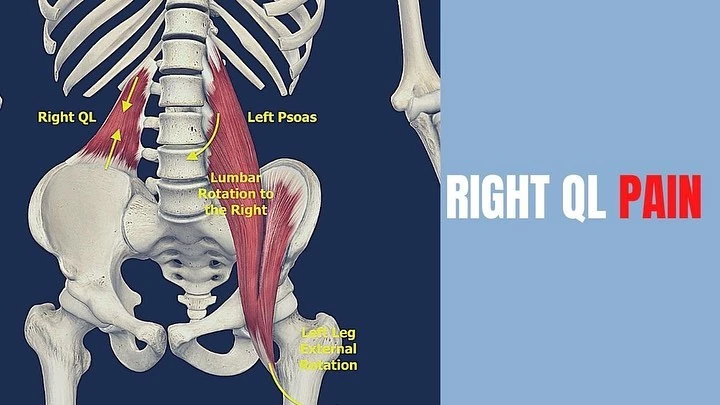
Both the psoas and the quadratus lumborum help to stabilise the lumbar spine and move the hips. The psoas runs from the lumbar spine down to the femur, playing a major role in hip flexion and spinal stability, while the quadratus lumborum sits along the side of the lower back, connecting the pelvis to the lowest rib and spine, and assists with side-bending and stabilising the pelvis.
The Dysfunctional Relationship
These two muscles are very often found in what can be described as a dysfunctional relationship, with one overworking while the other underworks. A common pattern seen in pelvic torsion is the quadratus lumborum on one side overworking while the psoas on that same side underworks, with the opposite pattern, the psoas overworking and the quadratus lumborum underworking, on the other side.
This kind of imbalance is often identified through approaches such as Neurokinetic Therapy (NKT), which specifically looks at how muscles compensate for one another rather than assessing each muscle in isolation. Research has also looked at how the activity of the psoas major and quadratus lumborum changes with different trunk and hip tasks and spinal curvatures while sitting, supporting the idea that these muscles work together dynamically rather than independently.
How This Shows Up as Pain
When the psoas and quadratus lumborum fall out of balance, the spine and pelvis lose some of their normal stability. Over time, this compensation pattern can contribute to lower back pain, particularly pain that seems to favour one side, or pain linked to prolonged sitting or hip flexor tightness.
How We Treat This Imbalance
Movement Assessment
Identifying which muscle is overworking and which is underworking, rather than simply treating “tightness”, is key to resolving this kind of pattern effectively.
Manual Therapy
Releasing the overworking muscle can help restore balance and reduce the compensatory strain it places on the spine and pelvis.
Targeted Strengthening
Activating and strengthening the underworking muscle helps it share the load properly again, rather than leaving its partner to compensate indefinitely.
When to See a Physiotherapist
If you have lower back pain that has not responded to general stretching or strengthening, or that seems to favour one side of your body, it is worth having the relationship between these two key muscles properly assessed.
FAQ
How do I know if my psoas or quadratus lumborum is the problem?
It is difficult to tell from symptoms alone, since both can refer pain into the lower back. A physiotherapist can assess which muscle is overworking and which is underworking through movement testing.
Is stretching enough to fix this imbalance?
Not usually on its own. Because one muscle is overworking and the other underworking, effective treatment typically needs to combine releasing the overactive muscle with strengthening the underactive one.
Can this imbalance come back after treatment?
It can, particularly if the underlying movement habits that created it, such as prolonged sitting, are not addressed. A tailored exercise programme helps maintain the improvement.
Ready to get started? Book your Initial Physiotherapy Assessment today.