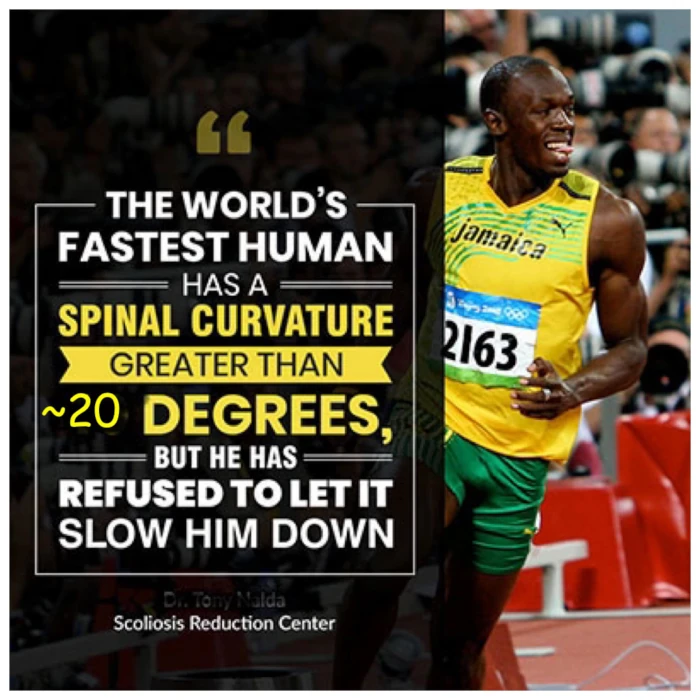
When patients with chronic back pain ask whether their scoliosis is the reason for their pain, one of the most reassuring examples is Usain Bolt. Bolt, an eight-time Olympic gold medallist and the only sprinter to win the Olympic 100m and 200m titles at three consecutive Games (2008, 2012 and 2016), has scoliosis, just like many of the patients asking the question.
What Is Scoliosis?
Scoliosis is a sideways curvature of the spine. It can vary widely in degree, from mild curves that cause little or no symptoms, to more significant curves that affect posture and, in some cases, contribute to pain. Having scoliosis does not automatically mean a person cannot move well, be strong, or be physically active at a high level, as Bolt himself demonstrates.
What Usain Bolt Shows Us
Beyond the obvious talent, Bolt displays not only core strength but incredible control of his spinal movements, precise technique, and excellent power and stability through his glutes. While scoliosis places the spine in a less symmetrical starting position, strength, control and technique around that spine can still be developed to a very high level.
How Physiotherapy Helps With Scoliosis
Most of us will never reach Bolt’s level of athletic ability, but there is always room for improvement. Physiotherapy can identify areas of abnormal muscle tone and weakness that place extra stress on an already asymmetrical spinal posture.
Movement Assessment
A physiotherapist can assess how the curve affects your posture and movement patterns, identifying which muscles are overworking and which are underactive as a result.
Targeted Strengthening
Building core strength and control around the spine, in the same way Bolt’s training supports his, helps the spine and surrounding muscles work more efficiently, which can reduce pain and improve function.
Postural and Movement Retraining
Improving spinal control and movement technique can noticeably improve comfort and physical performance, whether your goal is pain-free daily life or better athletic performance.
What to Expect
We cannot promise you will crack the 10-second mark over 100m, but a structured physiotherapy programme can bring a noticeable improvement in comfort, movement quality and athletic ability, whatever level you are starting from.
When to See a Physiotherapist
If you have scoliosis and are experiencing back pain, stiffness, or feel your posture is limiting your activity, it is worth having your spine and surrounding muscles properly assessed rather than assuming pain is simply something you have to live with.
FAQ
Does scoliosis always cause back pain?
No. Many people with scoliosis have little or no pain, particularly with mild curves. When pain does occur, it is often related to muscle imbalance around the spine rather than the curve itself.
Can physiotherapy straighten a scoliotic curve?
Physiotherapy is not typically able to reverse a structural curve, but it can improve strength, control and posture around the spine, which often reduces pain and improves function significantly.
Can someone with scoliosis still do sport at a high level?
Yes. Usain Bolt is a well-known example of elite performance alongside scoliosis. With the right strength, control and technique work, scoliosis does not have to be a barrier to an active life.
Ready to get started? Book your Initial Physiotherapy Assessment today.